
Mastering Fraud Solution Implementation - Importance of Leadership and Unified Priorities.
Why fraud implementation needs an engaged executive sponsor and a clearly communicated company-wide priority, illustrated through practical delivery experiences.
 By Ivan Skula
July 31, 2024
By Ivan Skula
July 31, 2024
In enterprise fraud management implementation, success or failure hinges on many factors and seemingly small details. In this post, we will discuss two critical factors: executive sponsorship and company-wide prioritization. Let's explore the importance of pairing the project with the right executive-level sponsor and building organization-wide understanding of the project's value.
Why Executive Sponsorship Matters
An engaged executive project sponsor provides strategic oversight and ensures the project's alignment with organizational goals. They act as a key decision-maker for major approvals and resource allocation. They also serve as a crucial link between the project team and senior leadership, offering guidance and support while being informed about project progress and outcomes.
In a much cleaner form: "an executive sponsor is a senior manager serving in a formal role given authority and responsibility for successful completion of a project deemed strategic to an organization’s success" 1
From a RACI matrix perspective and depending on the phase of the project, the executive sponsor is
- Accountable for approvals and strategic goals alignment
- Consulted on major decisions or material changes
- Informed about overall progress and final outcomes
"As per KPMG, 68% of companies do not always have an effective sponsor." 2
The problem with sponsorship usually lies in the following situations:
- Sponsorship Overload: When the executive oversees multiple equally demanding initiatives, especially if they span across many teams within the organization.
- Sponsor's Role Disconnect: Occurs when a clear gap or misalignment exists between the sponsor's role and expertise and the initiative's actual requirements. This includes lack of clear vision or knowledge, poor communication, resistance to change, etc.
- Sponsor's Insufficient Authority and Support from Leadership: Happens when the sponsor lacks sufficient authority to make critical decisions and allocate resources effectively.
One example of an engaged and effective sponsor was when our project required additional storage capacity because we needed to capture and store more data. The meeting stalled on responsibility and revolved around why this wasn't captured earlier, until the sponsor stepped in and asked how much the additional storage would cost. After receiving an approximate figure from an IT representative, he noted that the 15-minute discussion involving everyone in the room cost more than the storage needed to move on. He asked the PM whether the project had any budget buffer, which the PM confirmed, so he immediately approved the necessary spending and closed the point.
Establishing Company-Wide Priority for Project
Many years ago, Bank X kicked off their multi-year enterprise fraud solution project. They were very strict about timelines, but as the weeks went by, the project dragged and began to slip. After another bi-weekly steering committee, the project plan clearly showed growing delays, and senior management started to question the task estimates, worrying about further delays down the line. Bank X was running 24 other projects in parallel with ours. We explained that most items were pending with teams within the organization. At the next steering committee, the General Manager stood up in front of all senior stakeholders and clearly stated that our (fraud) project was the number one project in the bank and that he expected all questions or pending items to be addressed first if they landed on someone's to-do list. He was a person of great influence within the organization, and everyone in the room understood the weight of that statement. From that meeting onward, employees at Bank X had practically no delays. This sponsor was a shining example of authority and leadership, and he wasn't even a "banker"; his previous experience was in retail.
KPMG's survey reported that in 2010, organizations completed up to 5 projects, 21 in 2012, and 30 in 2017. A 2016 survey from PM Solutions reports that small organizations work on an average of 40 projects per year, while large organizations handle up to 100 projects annually 3.
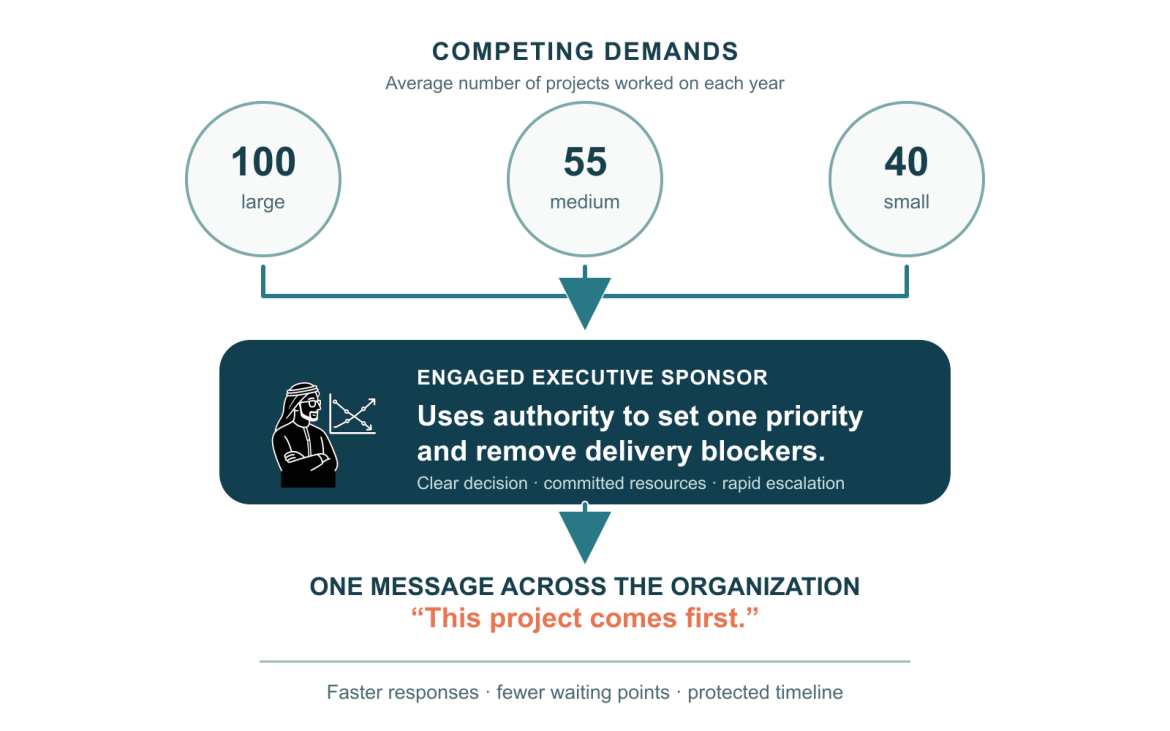
Running an enterprise fraud implementation project is, if not the biggest, one of the biggest projects happening within any organization. Fraud projects addressing various types of fraud often require lengthy discussions with various units - PMO, IT, Legal, Information Security, Fraud Business, Internal Audit, and others. Depending on the project scope, this engagement can last from a couple of months to multiple years. Managing such a wide group of people across various project stages and tracking the tasks that need to be completed usually requires a dedicated PM on both sides. Therefore, it is paramount to establish and communicate the overall priorities of projects running simultaneously. In my experience, almost all fraud projects were treated as the highest priority, even if they weren't communicated as such at the very beginning.
One of my most memorable experiences that touches on both points discussed today involves implementing an enterprise fraud solution for a medium-sized bank in the GCC. Time was critical, and we had to meet the go-live date. During the KICK-OFF meeting, as we went through the presentation, we reached the point where we said that, to meet the tight timelines, the project had to be prioritized, and this had to be communicated across the organization. Everyone listened silently when we re-emphasized this point. Suddenly, the CEO asked us whether we knew how many vendors were asking the same thing for their projects. The tension grew, but we continued to explain why, in our case, we truly stood behind this statement and why it was of utmost importance to meet the timelines. After some exchanges between our team and the CEO, the tension subsided, and the CEO came up unexpectedly with a very bold proposal. He asked his team to allocate a substantial amount of money as a reward to be distributed among the project team only if the project was delivered on time. If that wasn't bold enough, he explicitly stated that the whole project team, including the vendor's people on the project, should be included. It won't come as a surprise to tell you that the project was delivered ahead of schedule; not only was it delivered in the shortest time to date (given the scope), but it was also considered highly successful by the bank's senior management, achieving the desired objectives. The team worked hard and as one team, eliminating the usual customer-vendor disputes.
Conclusion
Organizations planning to implement a new fraud solution should ensure the project is led by the right executive sponsor, with sufficient domain understanding and the authority to make necessary decisions. Whether you are a vendor or an employee of an organization implementing fraud solutions, make sure the project's importance within the organization is established and communicated across all levels.
Remember, successful fraud solution implementation isn't just about the technology and capabilities provided to the business owner; executive support, leadership, and clearly defined project priorities also play important roles. By securing a strong executive sponsor and ensuring a company-wide understanding of the project's importance, you set the stage for an effective, successful implementation.
References & Further Reading
[1] Improving Executive Sponsorship of Projects: A Holistic Approach
Business Expert Press; ISBN 9781631574115. Locally preserved PDF.
[2] Executive Engagement: The Role of the Sponsor
Locally preserved executive-sponsorship report.
PM Solutions research on project-management office maturity, functions and contribution to strategy execution. Publisher-hosted 2016 report.